

The Goodist

My husband used to say that I was so rational and logical because I didn’t get hormones from a regular period.
And I was proud of that.
Yes, I was proud. Not embarrassed that my body wasn’t doing what bodies do. Not concerned about what it might mean for my health. Proud. Because what he was really saying, and what I was really hearing, was: you’re not like other women. You’re not overly emotional. You’re not high maintenance. You’re reasonable. Logical.
I had spent a long time working very hard to be reasonable - most of my childhood in fact.
I’m reading John Sarno’s The Divided Mind right now and there is a word he uses - being a “goodist.” A goodist is someone who has an extraordinarily strong need to be good, to be seen as good, to be perceived as reasonable, generous, capable, not too much, not a burden, not the kind of person who makes things harder for everyone else…. ummmm, yes, hi, that’s me.
Sarno argues that goodists carry an enormous amount of buried rage. Not because they are secretly angry people, but because the gap between what they feel and what they allow themselves to express is so wide, and has been so wide for so long, that the unexpressed accumulates somewhere it can’t be seen.
And then it goes somewhere.
His sequence lands like this: buried rage becomes guilt, guilt becomes low self-worth, and somewhere in that chain the body starts producing symptoms. Pain. Nausea. Fatigue. Tension. The physical becomes the focus because the physical is manageable in a way the emotional is not. You can treat a symptom. You can research it, address it, solve for it. The rage underneath is harder to look at directly, especially if you have spent your whole life being proud of not being the kind of person who has rage… again, yes, hi, that’s me.
I didn’t have a regular period growing up. There were real physical reasons for that, and I’m not collapsing a complex health history into one clean explanation. But I also know now what I didn’t know then: my body was not a safe place to feel things. Not because anyone told me that directly. Because I had learned, early and well, that emotions were something to manage, not something to move through. That being seen as rational was safer than being seen as feeling. That not being high maintenance was something worth being proud of.
My body was keeping score the whole time.
Bessel van der Kolk wrote that phrase and I have used it many times with clients. But reading Sarno alongside it is adding a layer I hadn’t fully considered before. It’s not just that the body keeps the score. It’s that the mind actively recruits the body to keep everyone, including the self, distracted from what’s actually on the scoreboard.
I was so good at being reasonable that I didn’t notice what it was costing me.
The perfectionism. The people-pleasing. The need to be seen a certain way, not misunderstood, not too much, not the kind of woman who makes other people uncomfortable with her feelings. Those aren’t character flaws. Sarno would say they are the exact profile of someone whose nervous system learned that emotions were not safe to feel and found a very efficient workaround.
The workaround worked. Until it didn’t.
I’m still reading and reflecting on what it means that I was proud of something that was actually my body’s way of telling me it wasn’t okay. That’s not a comfortable thing to look at directly.
But I’m looking.
What did you learn to be proud of that might have been your nervous system’s way of coping?
A little note.
This is close to the work I actually do with women one-on-one.
We take whatever feels tangled right now, a pattern, a reaction, a thing you can’t quite name, and slow down enough to see what it’s actually made of. Not so you can push through it faster. So you can trust yourself inside it.
If that’s something you want to talk through, I offer a free 20-minute call.
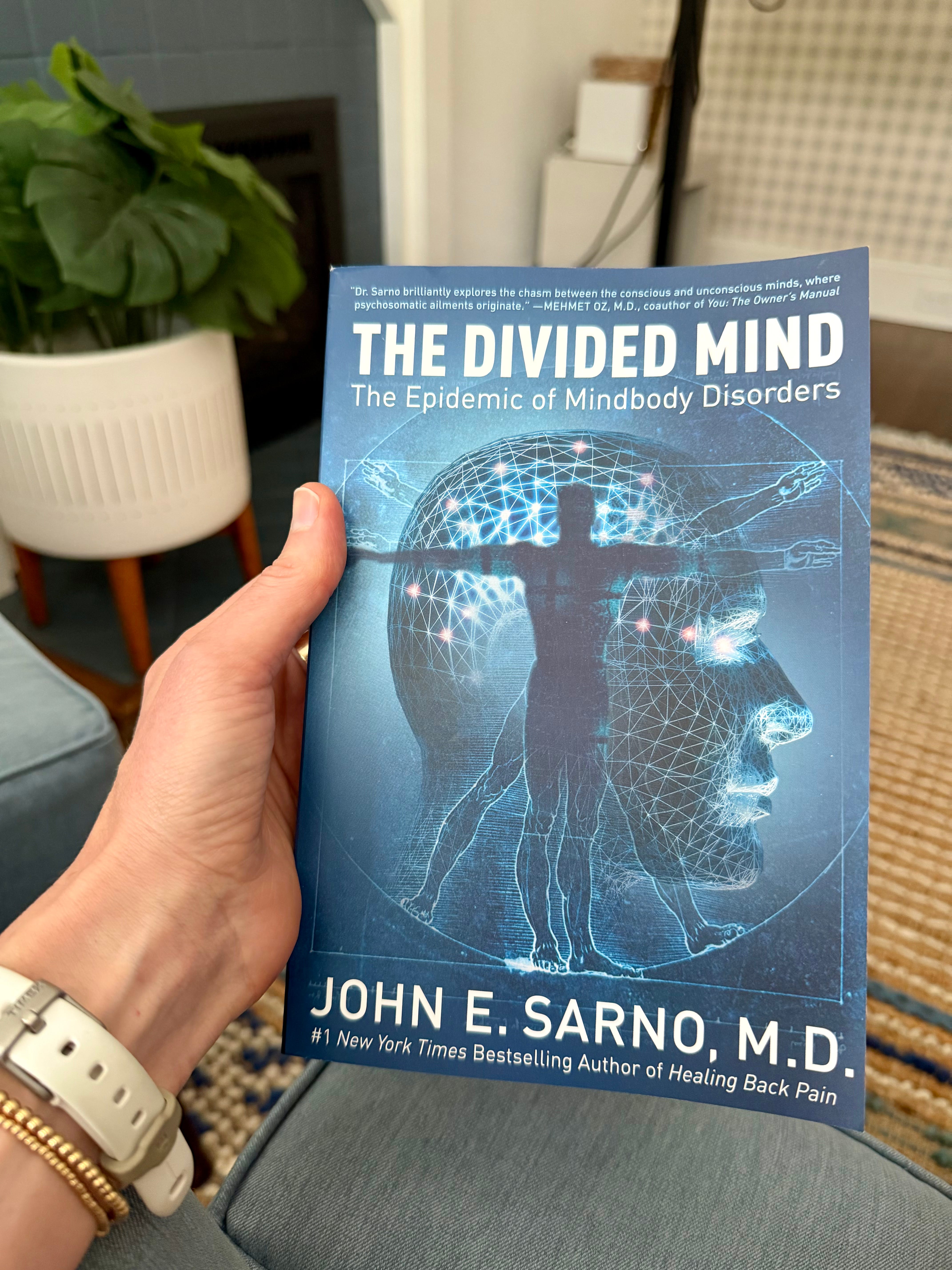
I am awed by how much “science” has to expand in regards to the body-mind connection.
Grateful for all who are expanding the understanding of that connection